
Oktoberfest 2026 Guide: Beer Prices, Best Tents and What to Wear
Oktoberfest 2026 runs from 19 September to 4 October at the Theresienwiese in Munich. Entry is free. A litre of beer costs €14.80 to €15.90 and half a roast chicken €16.40 to €23.50. Tents open at 10:00 on weekdays and 09:00 at weekends, with last orders at 22:30.
Oktoberfest 2026 Guide: Beer Prices, Best Tents and What to Wear
TL;DR: Oktoberfest 2026 runs from 19 September to 4 October at the Theresienwiese in Munich. Getting in costs nothing. A litre of beer is €14.80 to €15.90, half a roast chicken is another €16.40 to €23.50, and a day for two with food and a few beers lands around €150. Turn up at 10:00 on a Tuesday and you will walk into a seat. Turn up at noon on the opening Saturday without a reservation and you will spend the day outside, looking in through the glass at people having a better time than you.
When is Oktoberfest 2026?
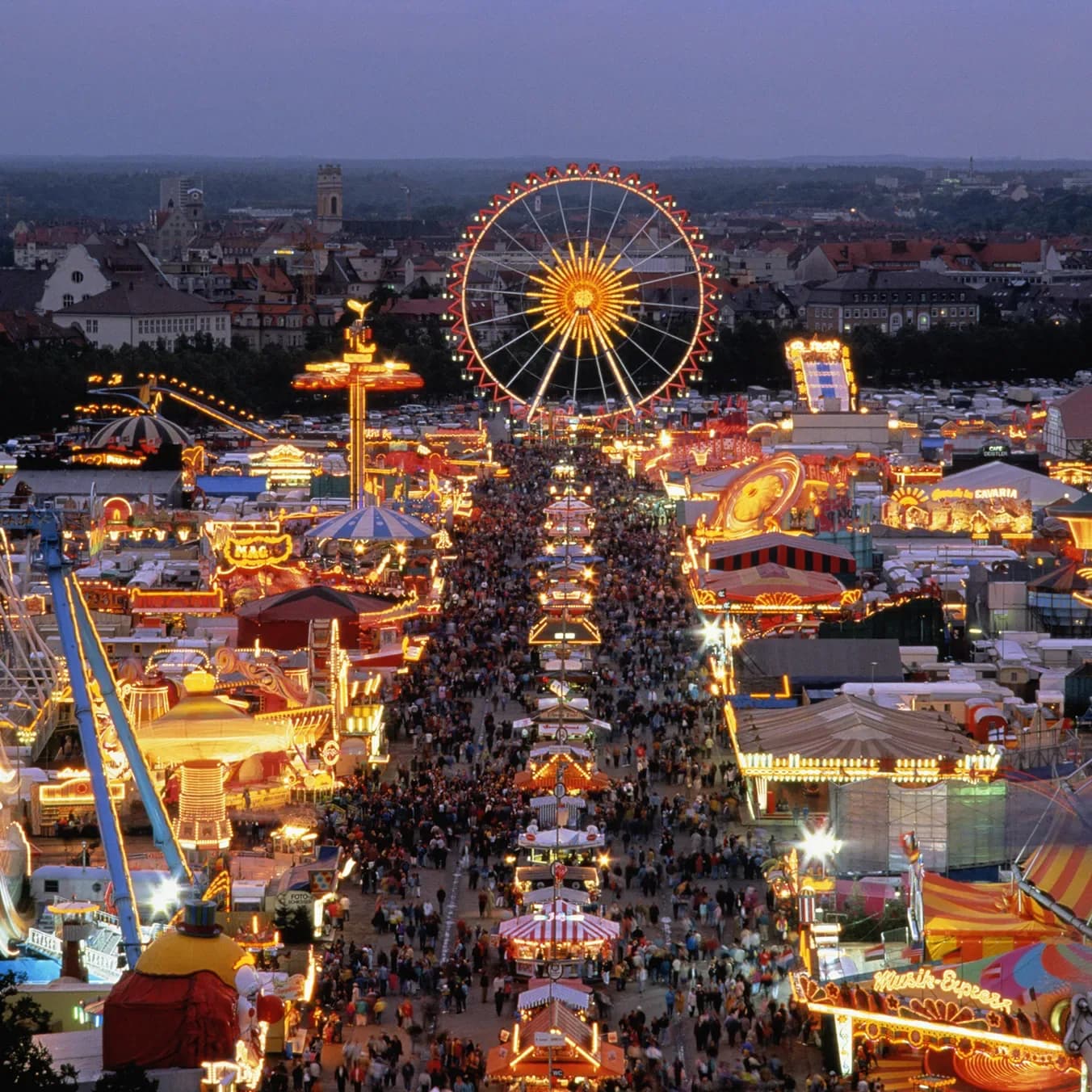
19 September to 4 October 2026. Sixteen days, and it is the 191st one. It is held on the Theresienwiese, a 42 hectare patch of open ground about a mile southwest of Munich city centre, which sits empty for most of the year and then becomes the biggest folk festival on earth for a fortnight.
The name is a lie and has been since 1872. It mostly happens in September, because the weather in late September is kinder than in October. Roughly 6.5 million people came in 2025, and they drank about 6.5 million litres between them.
- Tents open: 10:00 on weekdays, 09:00 on Saturdays, Sundays and 3 October.
- Last beer: 22:30. Tents close at 23:30. Kaefer Wiesn-Schaenke and the Weinzelt run to 01:00, with last orders at 00:30.
- Opening day: Saturday 19 September. The Mayor taps the first keg in the Schottenhamel at noon and shouts "O'zapft is!". Nobody gets served anywhere on the grounds until he does.
- Entry: free, to the grounds and to every tent. The only thing you pay to enter is the Oide Wiesn, at €4.
- Closing day: Sunday 4 October. Gun salute at the Bavaria statue at noon, then the Kehraus at night, when the bands play their last set and the staff hand out sparklers.
What does Oktoberfest actually cost in 2026?
This is the bit people get wrong. The festival is free to walk into, so it feels cheap until the first round arrives. All prices below are in euros, which is what you will actually pay. Pound figures use €1 = £0.86, the rate on 17 September 2026, so check it before you go.
Beer
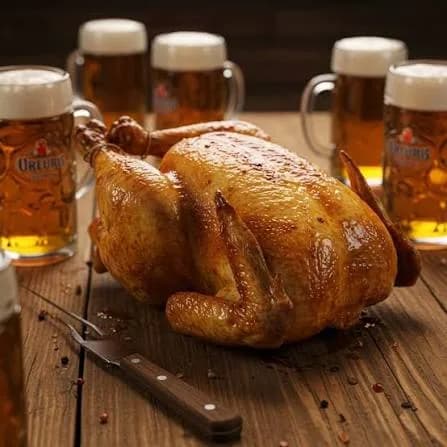
A Mass is one litre. The 2026 average across the whole Wiesn is €15.61, about £13.40, up roughly 2.4 percent on last year. The spread by tent:
- Cheapest anywhere: €14.80 (about £12.75) at the Museumszelt on the Oide Wiesn and at the Familienplatzl.
- Cheapest big tent: €14.90 at the Augustiner-Festhalle, which is also the only big tent still pouring from wooden barrels. That is not a coincidence, it is the tent the locals go to.
- Most big tents: €15.80. Hacker, Hofbraeu, Paulaner, Schottenhamel, Marstall, Ochsenbraterei, Kaefer, Schuetzen.
- Dearest: €15.90 at the Armbrustschuetzenzelt, Braeurosl and the Loewenbraeu-Festzelt.
- The outlier: €18.40 in Kufflers Weinzelt, and that is for a litre of wheat beer, because the Weinzelt does not serve the standard festival lager at all.
Not drinking is expensive too. A litre of table water is €11.13, lemonade is €12.47 and a Spezi is €12.84. Alcohol free beer averages €15.73, which is more than the real stuff. There are ten free drinking water fountains on the grounds, and you should find the nearest one to your tent early rather than at 21:00.
Food
The food is genuinely good and genuinely not cheap. Half a roast chicken, the Hendl, is the default order and the fairest price comparison between tents.
- Half roast chicken (Hendl): €16.40 at Festzelt Tradition, €16.90 at the Ochsenbraterei, up to €23.50 at Kaefer and Fischer-Vroni. Roughly £14 to £20.
- Pork knuckle (Schweinshaxe): €24.90 at Braeurosl and Augustiner, €29.20 at Loewenbraeu, €31.00 in the Weinzelt.
- Pretzel (Brezn): about €7 to €9 for a proper tent-sized one. The small ones off a stall are cheaper.
- Obatzda, the cheese spread: €15.10 at Augustiner up to €19.50 in the Weinzelt.
- Kaiserschmarrn: €14.90 at the Schuetzenlisl, €27.50 at Braeurosl. Same pudding, nearly double the money. Worth knowing before you order it on a whim.
- Cheese spaetzle: €17.90 at Augustiner to €22.50 at Hacker.
- Grilled fish on a stick (Steckerlfisch): around €5.40 per 100g, so €13 to €22 for a whole one depending on size.
- Chips: €9.70 at Loewenbraeu. For chips.
If you want the cheap version of this day, the pattern is obvious once you see it laid out: Augustiner for the beer, Ochsenbraterei or Festzelt Tradition for the chicken. That combination saves about €8 a head against the dearest tents without giving up anything worth having.
Rides and the Oide Wiesn
The 2026 ride prices are not published yet, because the survey that produces them happens on the first Saturday. These are the 2025 figures and they historically move by well under a euro:
- Big wheel (Riesenrad): €11 adult, €4 child.
- Olympia Looping, the five loop coaster: €14, and it is the best ride on the grounds.
- Toboggan: €6. The moving conveyor belt you have to walk up. Watching people fail at it is free, and it is the single funniest thing on the Wiesn.
- Teufelsrad: €5 to go on, free to watch from the stands. A spinning wooden disc that throws volunteers off while a man on a microphone mocks them.
- Ghost train, Musikexpress, Krinoline: €5 to €6.
The Oide Wiesn is the historic section at the south end, and it is the one part with an entry fee: €4 for anyone 15 or over, free for under 15s, and free for everyone after 21:00. Every ride inside it is a flat €1.50, the carousels date back to 1919, and the beer is €14.80 to €15.80. If you are bringing children, or you want to hear actual Bavarian brass rather than Sweet Caroline, go here. Tuesday 22 and Tuesday 29 September are family days, with ride prices cut until 19:00.
The bit that hurts: beds
Munich hotels charge two to five times their normal rate during the Wiesn, and the opening weekend is the worst of it. One tracked comparison had a mid range hotel go from €194 to €623 for the same room. A youth hostel bed went from €113 to €175. If you have not booked by now for 2026, look at Augsburg or Ingolstadt and take the train in, or do it as a day trip and skip the bed entirely.
The beer: what you are actually drinking
Only six breweries may serve at Oktoberfest: Augustiner, Hacker-Pschorr, Hofbraeu, Loewenbraeu, Paulaner and Spaten. Most guides tell you this is because of the Reinheitsgebot, the purity law. That is wrong, and it is worth knowing why. Every German brewery follows the purity law. The six brewery rule comes from Munich's own festival operating regulations, which say the beer must be brewed inside the city limits by a brewery that demonstrably keeps up Munich brewing tradition. A court upheld it in 1990 on the grounds that Oktoberfest is the festival of Munich beer. Giesinger Braeu, the city's newest brewery, is currently running a citizens' petition to be let in.
Oktoberfestbier has been an EU protected term since 2022. The specification sets a minimum original gravity of 13.6 percent and an alcohol range of 5.3 to 6.6 percent. Here is what that means for you: it is about a third stronger than the lager you drink at home, it does not taste like it, and it is served in litres.
The 2026 strengths, from this year's official tasting:
- Augustiner 6.3 percent. The palest of the six and the strongest. Fresh, floral, soft bitterness. Won the Abendzeitung's blind tasting and is the one Muencheners name most often.
- Loewenbraeu 6.1 percent. Hop forward, floral, uncomplicated. Came second in the same blind test.
- Hofbraeu 6.0 percent. The sweetest of the six, and tasters marked it down for not having enough bitterness to balance it.
- Hacker-Pschorr 5.9 percent. Amber, the darkest, properly malty. The closest thing left to a real Maerzen.
- Paulaner 5.9 percent. Malt led, fruity finish, mild. The easy one.
- Spaten 5.9 percent. Caramel nose, sweet up front, balanced. Poured at the Schottenhamel, so it is the first beer of the festival every year.
Do the maths before you commit to an afternoon. One Mass at 6 percent is 6 UK units, which is about two and a bit pints of ordinary 5 percent lager. Three of them puts you past the entire UK weekly guideline of 14 units, in one sitting, usually before dinner. This is the whole explanation for the Bierleiche, the beer corpse, which is the Munich term for someone the medics have to carry out. The first one of 2025 was collected shortly after the opening tap at 2.9 parts per thousand blood alcohol.
Radler, Russn and the wine tent
If a litre of 6 percent is too much, order down rather than going home. A Radler is half lager and half clear lemonade, invented in 1922 at the Kugler-Alm when a landlord got 13,000 cyclists turning up at once and had to make his beer go further. A Russn is the same trick with wheat beer instead of lager. Both come as a full Mass at the same price as beer, at roughly half the alcohol, and no Bavarian will think less of you for it. Do not ask for an Alsterwasser, which is the northern German word for the same drink and marks you out instantly.
Kufflers Weinzelt is the one tent with no festival lager at all. Wine, sparkling wine, and Paulaner wheat beer until 21:00. It is older, dressier and open until 01:00, and it is where people go when the other tents have shut.
Check your beer is a full litre
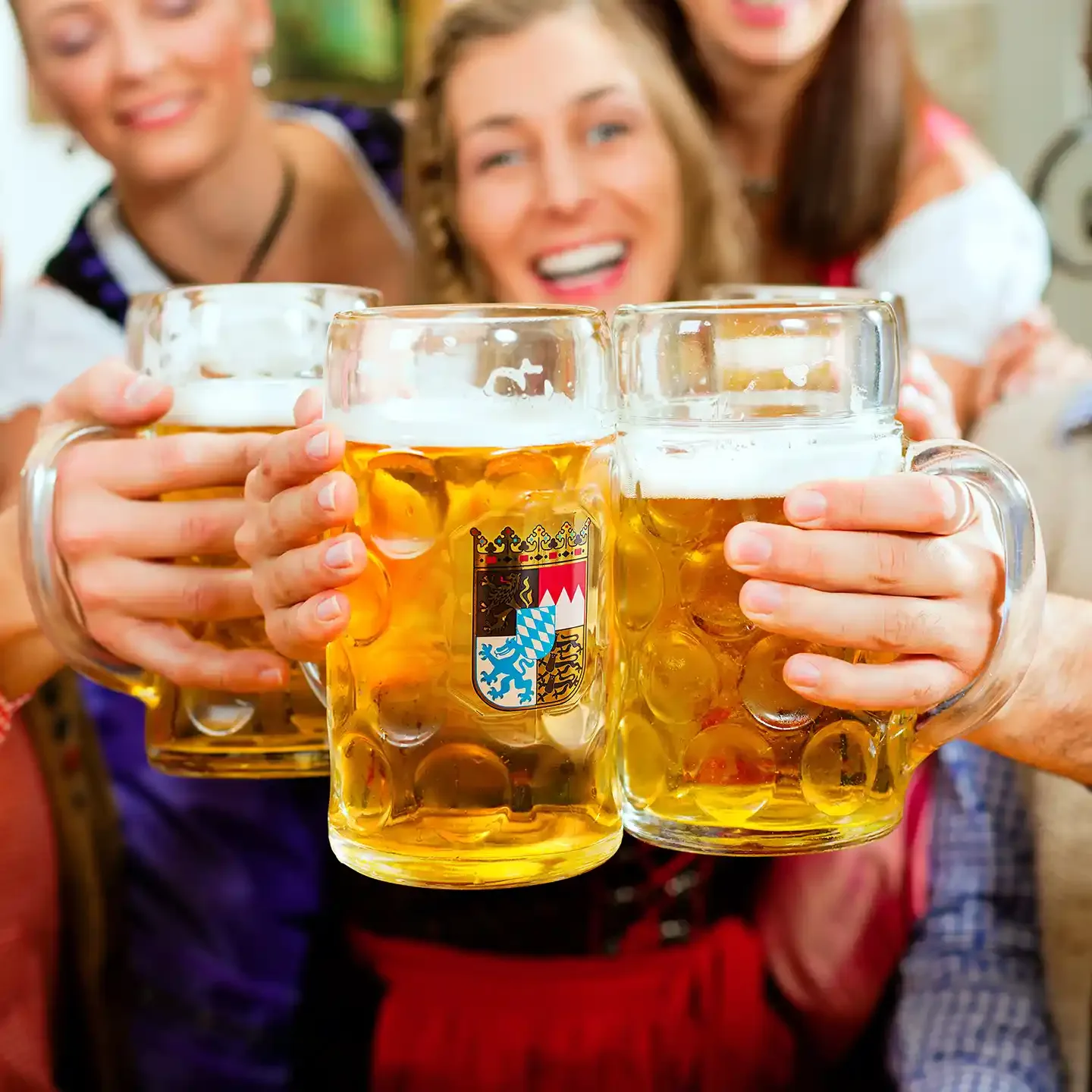
This is the most useful thing in this guide. Every Mass glass has an Eichstrich, a calibration line at exactly one litre, with the space above it for the head. By law the beer must reach within 15 millimetres of that line. The city's inspectors, 39 of them working in pairs, found roughly one mug in three underfilled the last time they measured, and one independent test found only 14 percent held an actual full litre.
You are entitled to object and ask for it to be topped up. Let the foam settle for a minute, look at the line, and if it is well short say "nachschenken, bitte" before you hand over the money. At €15.61 a litre, one short pour in three is not a rounding error.
The tents: the best, the worst and the one to avoid
There are 17 large tents in 2026 and 21 small ones. They are not interchangeable. Picking the wrong one is the difference between a proper day and four hours of a stag party from Reading singing at you.
The best tents
- Augustiner-Festhalle, 8,500 seats. The best tent on the Wiesn and it is not close. Cheapest beer of the big tents at €14.90, the only one still serving from wooden barrels, the most local crowd and by some distance the fewest people falling over. Family friendly. The catch: reservations are effectively shut, because the same families have held the same tables for years.
- Ochsenbraterei, 5,950 seats. An ox on a spit since 1881, and a counter telling you which ox you are eating. Mid sized, relaxed, the best food of the big tents. If you want atmosphere without chaos, start here.
- Hacker-Festzelt, 9,300 seats. The Himmel der Bayern, with a painted sky ceiling that opens and a revolving stage. It is a party tent, but the local to tourist balance is much better than Hofbraeu, and the last night finale is the best thing that happens at the festival.
- Fischer-Vroni, 3,780 seats. Grilled fish over open flame, a wooden fishing boat in the middle, and a cosy feel the big tents cannot manage. Hosts Pink Monday.
- Schuetzen-Festzelt, around 5,400 seats. Tucked under the Bavaria statue with 110 shooting stands along one side. Calmer and traditional, good on a weekday afternoon.
The one everybody warns you about
The Hofbraeu-Festzelt. It is the biggest, the loudest and the only tent with a proper standing area in front of the band, which is exactly why it has become the international tent. Australians, Americans, Brits, and a reputation among Muencheners as the place they do not go. It is not a bad tent. It is a very good tent full of people who flew in specifically to get destroyed in it, and if that is the day you came for then you have found it. If it is not, go literally anywhere else.
Two more you will not get into: Kaefer Wiesn-Schaenke, the celebrity tent, which is a solid chalet rather than canvas, and the Marstall, which is elegant, equestrian themed and essentially reservation only. Both are booked months out.
The rest of the big fourteen
- Schottenhamel, around 9,000 seats. The oldest, from 1867, and where the keg is tapped at noon on day one. Young crowd, lots of students and first timers.
- Paulaner Festzelt (Winzerer Faehndl), around 8,400 seats. The giant rotating Mass on the tower. The most balanced of the huge tents and the safest choice for a first visit.
- Loewenbraeu-Festzelt, 8,500 seats. A 37 metre tower with a lion that roars. Football crowd, high energy, loud.
- Armbrustschuetzenzelt, around 7,400 seats. A crossbow competition has run here since 1895 and the range runs along one side. Traditional and quieter.
- Braeurosl, 8,250 seats. Yodelling, rebuilt in 2022, and host of Gay Sunday on the first Sunday.
- Marstall, around 4,300 seats. Upmarket, carousel shaped bandstand, hosts the church service.
- Kufflers Weinzelt, 2,500 seats. Wine, wheat beer, open till 01:00.
The small tents, which nobody tells you about
Twenty one of them, and they are the answer when the big tents shut their doors at 17:00 on a Saturday. They are also the more old fashioned, more genuinely Bavarian version of the whole thing.
- Gloeckle Wirt. 226 seats, cluttered with sledges and oil paintings and old kitchen junk, roaming musicians in the day and a band at night. A locals' tent.
- Heimer. Roast duck, 300 seats, and no live band at all. If you want to have a conversation, this is the one.
- Zur Bratwurst. Sausages over a wood fire and Augustiner from casks.
- Wildstuben. Alpine hunting lodge fit out, game meat, 271 seats.
- Wirtshaus im Schichtl. 120 seats, and a variety theatre that has been performing a mock beheading since 1869. Beer at €14.90.
- Cafe Kaiserschmarrn. Built as a replica of Neuschwanstein. Coffee and cake by day, wine and cocktails by night, no beer at all.
Best and worst areas of the grounds
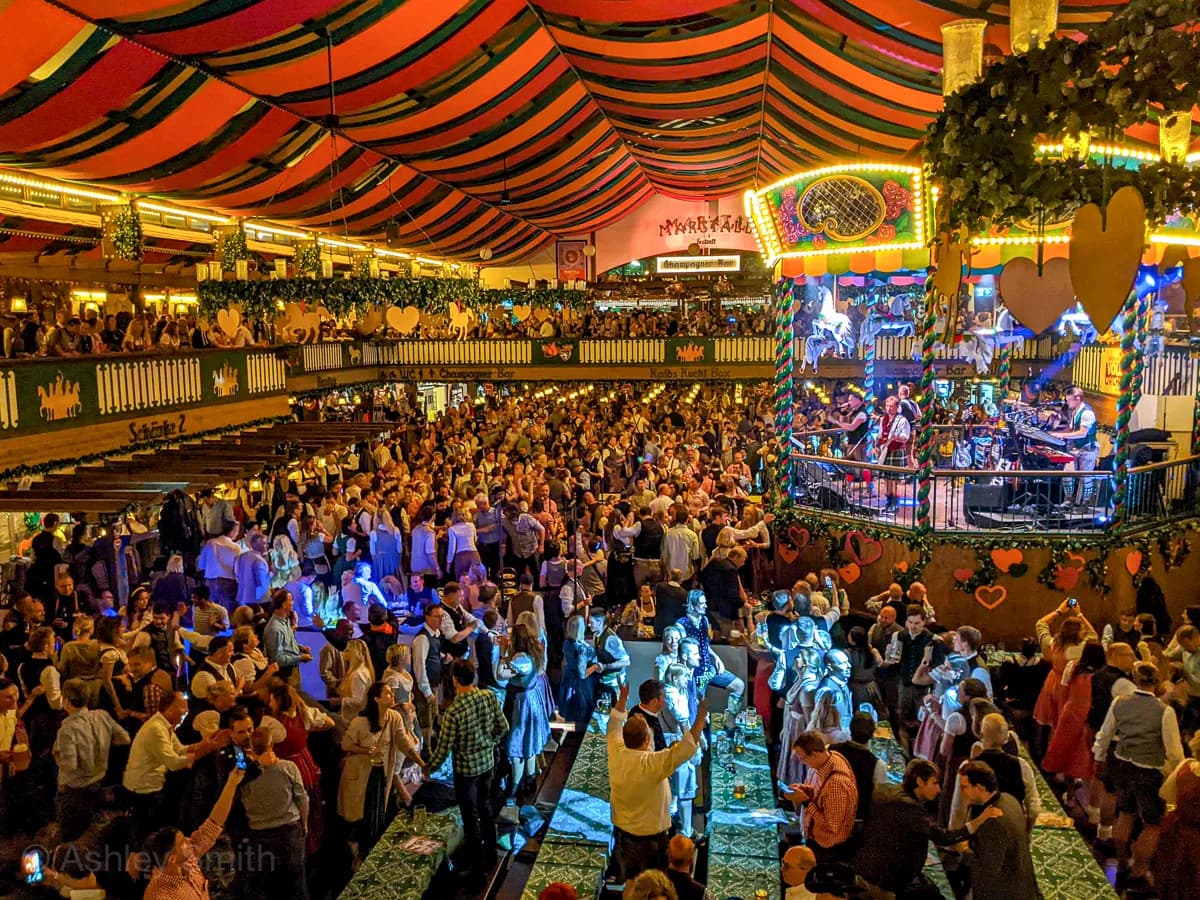
The Wiesn is laid out as two long strips. The big tents line the western spine along Wirtsbudenstrasse. The rides and the showmen sit on the eastern side along Schaustellerstrasse. The Oide Wiesn is fenced off at the south end. The Bavaria statue stands at the western edge and is the one landmark you can always navigate back to, which matters more than it sounds at 21:00.
- Best area for a first visit: the middle of the tent spine, around Hacker, Ochsenbraterei and Paulaner. You can move between three good tents in two minutes if one turns you away.
- Best area with children: the Oide Wiesn, then the Schuetzen and Armbrustschuetzen end near the Bavaria statue. Note that under 16s have to be out of the tents by 20:00 by city rule.
- Best area to eat: the small tent cluster. Better food, less queueing, a fraction of the noise.
- Worst area at peak: the main drag outside Hofbraeu and Schottenhamel between 17:00 and 20:00 on a Saturday. It is a solid crowd that moves at one speed, and it is where wallets go missing.
- Worst entrance: Theresienwiese U-Bahn. It is the closest and everyone knows it. Goetheplatz or Poccistrasse on the U3 and U6 put you in from the quieter side with a five minute walk.
How to get a seat without a reservation
Reservations for 2026 closed months ago. Most tents opened theirs between January and March, the good weekend slots went by mid April, and they cannot legally be resold privately, so anything you find on a resale site that is not the official portal will get cancelled at the door. That is fine. Most people get in without one.
The city forces every tent to hold seats back for walk ins:
- Weekdays: 25 percent of seats stay unreserved all day.
- Weekends and holidays: 40 percent unreserved until 15:00, then 25 percent.
- Oide Wiesn: a third of seats are always free.
So the whole game is arrival time. On a weekday, be at the door for 10:00 when the tents open and you will get a table you can keep all day. On a Saturday or Sunday the tents open at 09:00, you want to be there by 08:30, and serious queues start forming around 07:00. For the opening Saturday, if you actually want to be inside the Schottenhamel for the tapping, that is a 07:00 start at the latest.
One rule that catches people out badly: once a tent hits capacity and closes its doors, you cannot get back in without a reservation band. Stepping outside for fresh air at 18:00 on a Saturday is a one way decision.
If you did have a reservation, it works differently to a restaurant. Reservations are free, but you prepay vouchers you redeem at the table, usually two Mass and half a chicken per person, which works out around €42 to €55 a head or €420 to €550 for a table of ten. You book the whole table, eight to ten people, direct with each tent.
The best and worst days to go
- Quietest: Tuesdays, then Mondays and Wednesdays. The sweet spot in 2026 is Monday 28 to Wednesday 30 September. A weekday before 15:00 runs at roughly half capacity with tables actually free.
- Busiest: the opening Saturday 19 September, the costume parade on Sunday 20 September, the Italian weekend on 26 and 27 September when Italians make up about a fifth of all visitors, and the final weekend with 3 October falling on German Unity Day.
- The cheat code: rain. It cuts attendance by 20 to 30 percent. A wet Tuesday is the easiest day of the entire festival to walk into any tent you like.
What do people wear to Oktoberfest?
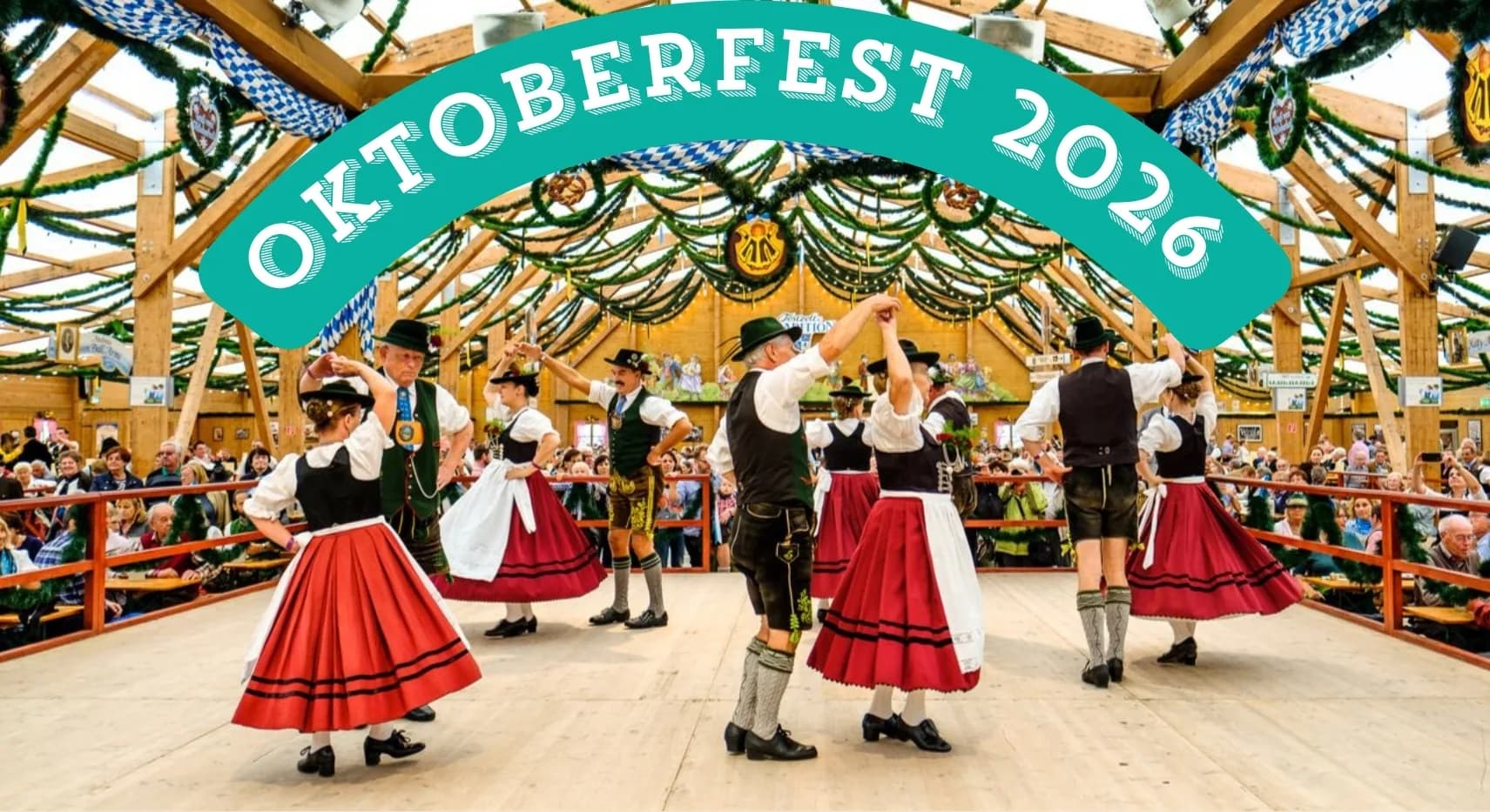
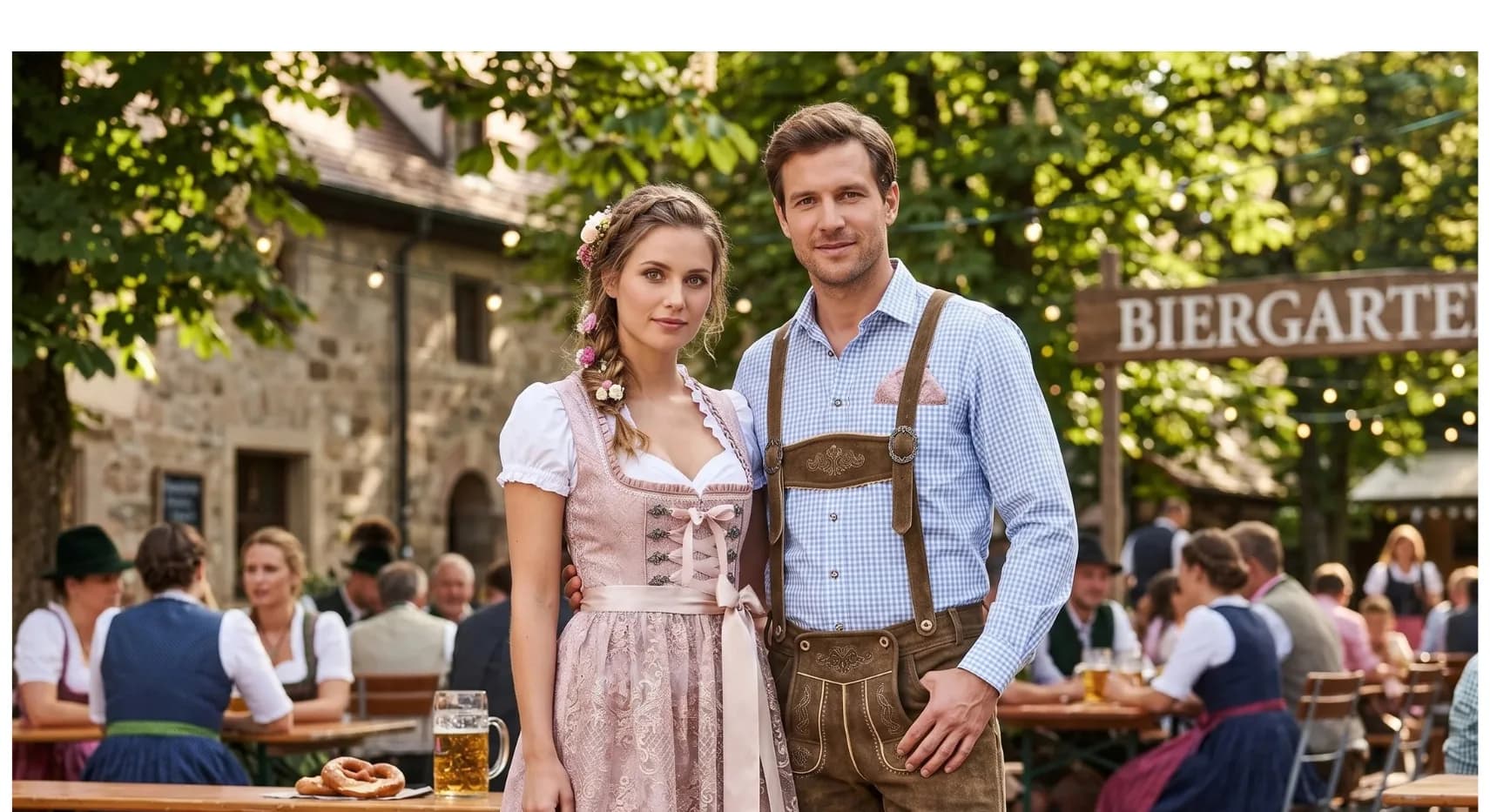
There is no dress code. The city says so outright: any outfit is permitted. Most people wear Tracht anyway, and visitors are genuinely welcome to, so the only real question is what you buy.
Men wear Lederhosen, either short or knee length, with a checked or plain shirt, Haferlschuhe (sturdy laced shoes), Loferl (two piece calf socks) and often a Janker jacket or waistcoat. Women wear a Dirndl, which is a bodice and skirt, with a blouse and an apron tied over it.
Prices split three ways. A real pair of goat leather Lederhosen starts around €200, deer leather from about €600, and a good new Dirndl from a Munich label runs from €549. Vintage is the smart middle: Dirndls from €30 to €300 and vintage Lederhosen from €250 at the Munich secondhand shops. For one trip, rent. A Lederhosen set with shirt and socks is about €49.90 and a Dirndl about €42.90, and it will look considerably better than the €30 polyester thing from the shop by the station. That cheap costume is the only outfit choice that actually reads badly to locals.
The tell for a real one: it smells of leather rather than chemicals, the embroidery is stitched rather than printed, and the leather is stitched rather than glued.
The dirndl bow rule, and why it is nonsense
Everyone will tell you this, so you should know it. The apron bow, tied from the wearer's own perspective: left means single, right means taken, front centre traditionally meant virgin or very young, back centre means widowed, or that she works there.
Here is the part no other guide mentions. It is not an old tradition. Bavarian heritage officials put its invention at some point in the 1980s. The regional heritage officer for the Oberpfalz calls it a relatively new story, the head of one of Munich's oldest Tracht houses says there is no historical evidence for it at all, and the Upper Bavarian heritage office describes it as peculiarly backward looking, given there is no male equivalent. Even the Tracht retailers concede the symbolism is not historically documented.
Tie it wherever you like. Just know that a tent full of people will read it as the code regardless, so if you would rather not have that conversation forty times, tie it on the right.
What to expect inside: the rules nobody tells you
- Eye contact when you clink. Every single time, with every person. Skipping it is genuinely rude. Hold the mug by the handle so your fingers are not between two colliding two kilo glasses.
- Benches yes, tables no. Standing and dancing on the bench is normal and expected. Standing on the table gets you removed, and the reason is structural rather than moral.
- Ein Prosit runs two or three times an hour. The bandleader calls for mugs up, everyone stands, and it ends with "Oans, zwoa, gsuffa". It was written by a journalist from Bremen in the 1890s, which nobody in the tent wants to hear.
- Tip in cash, per round. Round each Mass up by a euro or two. The servers are not on wages. They buy the beer from the landlord with their own money up front and take a cut, so the tip is the job.
- Four big tents are cash only: Augustiner, Braeurosl, Loewenbraeu and the Ochsenbraterei. Hacker, Hofbraeu, Kaefer, Marstall, Schottenhamel and Paulaner take cards. About half of all stalls now do. Bring cash anyway.
- The mug is not a souvenir. Taking a Masskrug home is theft and is prosecuted as theft. Buy one from the stand, they are marked differently.
The bag rule that ruins people's mornings
Rucksacks are banned outright. The maximum bag is 3 litres in volume and no bigger than 20 by 15 by 10 centimetres, and both limits apply. That is phone, wallet and keys, and not much else. A normal handbag will be turned away at the fence. There are left luggage points around the grounds at about €5 an item, but the queues are long and you will not want to do it twice. Also banned: glass bottles, anything bladed, bikes and scooters, and all animals except assistance dogs. Prams are barred entirely on the three Saturdays and on 3 October.
Staying in one piece
The medics treat around 7,000 people in a bad year, which is roughly one visitor in a thousand. Alcohol poisoning, circulatory collapse and cuts from broken glass, in that order. The 2025 police figures for the first eight days ran to 414 offences, including 29 pickpocketings, which is lower than the reputation suggests. Drunken loss is the real risk: 4,500 items were handed in during 2025, including 800 wallets and 400 phones.
The one that genuinely catches Brits: drink driving cases were up 74 percent in 2025, and 172 of the 285 were people on e-scooters. Riding one back to the hotel is not a clever shortcut, it is a criminal offence with the same threshold as a car.
The Wiesn lost property office sits at the Deutsches Museum Verkehrszentrum, Am Bavariapark 5, open daily 13:00 to 20:00 during the festival. Bring ID and a description.
Getting there from the UK
Munich is about a two hour flight from most UK airports, and Oktoberfest is one of the few festivals where a proper day trip genuinely works. Tents open at 10:00 on a weekday and stop serving at 22:30, so an early flight out and a late one back gives you the whole thing without paying Munich's Wiesn hotel prices, which run two to five times normal.
From the airport, the S1 and S8 take 35 to 45 minutes into the centre. The Airport-City-Day-Ticket is €17.50 single or €32.60 for a group of up to five, and the group one is the obvious call for three or more. The Lufthansa Express Bus is €12.50 booked online. A taxi is €65 to €85. Once you are in town, a single on the U-Bahn is €4.20, a Zone M day ticket is €10.10, and a group day ticket is €15.40, which again beats singles for any group.
For the fares, compare returns across multiple UK airports on BudgetBro Day Trips, which is built for exactly this: finding the cheap same day return that makes a trip like this work. Then keep the beer, the Hendl and the U-Bahn tickets in the BudgetBro app across 160+ currencies, because euros go quickly in a tent and nobody counts properly after the second Mass.
Oktoberfest 2026 is on the events calendar too, with the dates, the location and what to expect: Oktoberfest 2026 in Munich.
Frequently Asked Questions
How much is a beer at Oktoberfest 2026?
Between €14.80 and €15.90 for a litre, with an average of €15.61, roughly £13.40. The cheapest big tent is the Augustiner-Festhalle at €14.90. The Weinzelt charges €18.40, but that is for wheat beer.
Do you need tickets for Oktoberfest?
No. Entry to the grounds and to every tent is free. You only pay to enter the Oide Wiesn, at €4, and that is free for under 15s and free for everyone after 21:00. Table reservations exist but are not tickets, and for 2026 they are long gone.
Can you go to Oktoberfest without a reservation?
Yes, and most people do. Tents must keep 25 percent of seats free on weekdays and 40 percent until 15:00 at weekends. Arrive at 10:00 on a weekday or 08:30 at a weekend and you will get a table.
Which Oktoberfest tent is best?
The Augustiner-Festhalle, for the cheapest beer of the big tents, wooden barrels and a mostly local crowd. The Ochsenbraterei is the best for food. Avoid the Hofbraeu-Festzelt unless a very loud international party is specifically what you came for.
How strong is Oktoberfest beer?
Between 5.9 and 6.3 percent in 2026, served by the litre. One Mass is about 6 UK units, the same as two and a bit pints of normal lager. Three of them exceeds the whole UK weekly guideline.
Do you have to wear lederhosen to Oktoberfest?
No. There is no dress code and any outfit is allowed. Most people do wear Tracht, and renting is about €49.90 for a Lederhosen set or €42.90 for a Dirndl, which looks far better than a cheap costume.
What is the quietest day at Oktoberfest 2026?
Tuesday. Monday 28 to Wednesday 30 September is the quietest stretch of the festival. Avoid the opening Saturday, the Italian weekend on 26 and 27 September, and the closing weekend.
Can you pay by card at Oktoberfest?
In some tents. Hacker, Hofbraeu, Kaefer, Marstall, Schottenhamel and Paulaner take cards. Augustiner, Braeurosl, Loewenbraeu and the Ochsenbraterei are cash only. Bring cash.
Oktoberfest is one of the few trips where the planning genuinely pays for itself. Pick a Tuesday, pick Augustiner, get there for 10:00, and check the line on the glass. Track what you actually spend in the BudgetBro app so the only surprise you bring home is the hangover.
Comments
No comments yet. Be the first to share your thoughts.
Related Articles
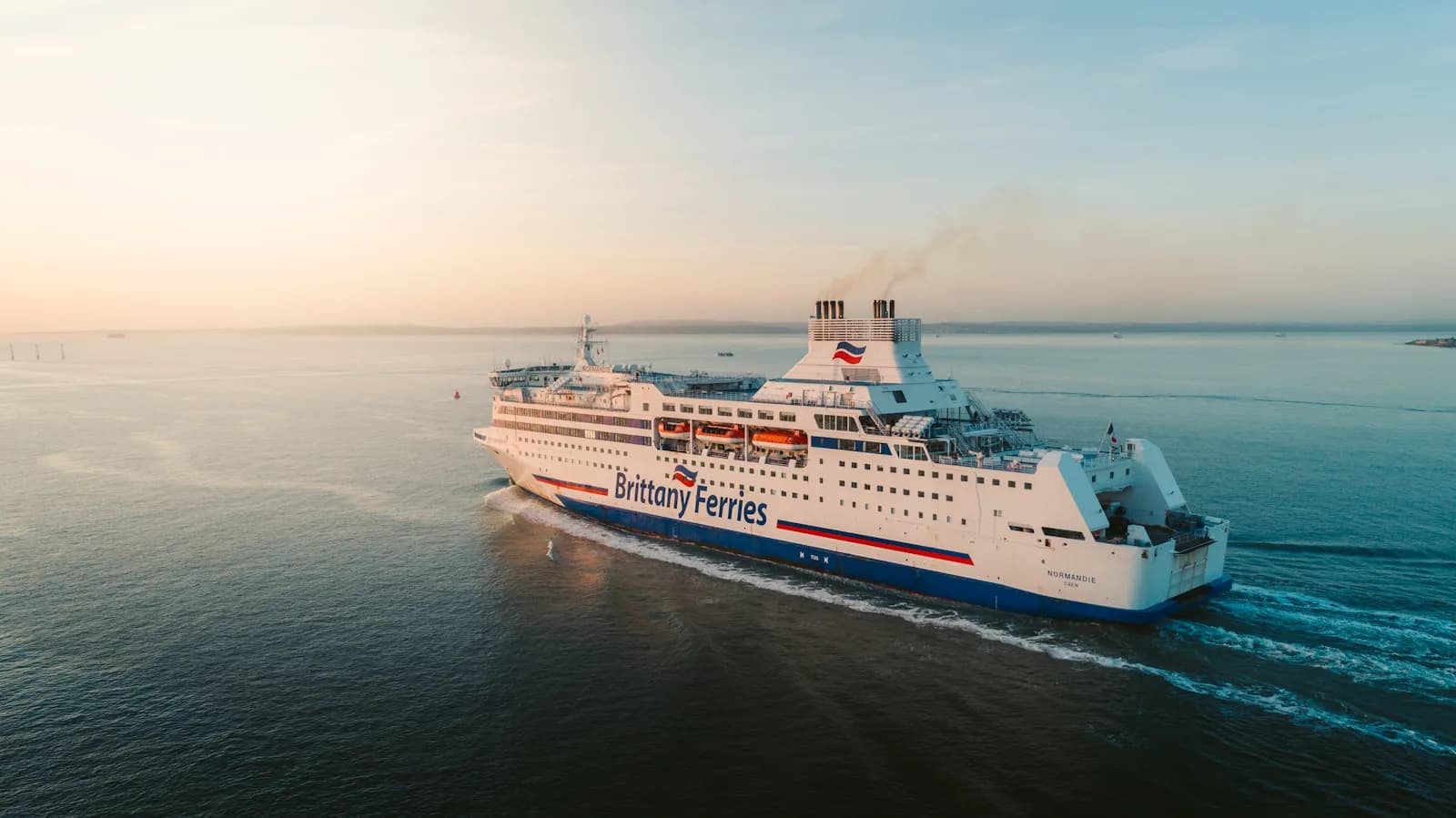
Passports Now Required for UK-Ireland Ferry Crossings
Starting this month you will be required to carry a passport on UK-Ireland routes. Driving licences and ID cards will no longer be accepted at boarding for ferries.
· 2 min read

Day Trip to Madrid from the UK: What 9 Hours Actually Cost Us
£32 flight from Manchester, 7 stops, every receipt logged. Here is the real number, the two places worth your money, and the famous sandwich I'd skip.
· 12 min read

Solar Eclipse 2026: Where to Watch in Europe
The first total solar eclipse over mainland Europe since 1999 crosses Iceland, northern Spain and Mallorca today (12th August 2026). This is where to stand for totality, when it happens, and which spots give you the best clear-sky odds.
· 8 min read
Latest Articles
View all articles
Athens Nomad Fest
A week of talks, masterminds, excursions, and cultural immersion in Athens.
· 1 min read
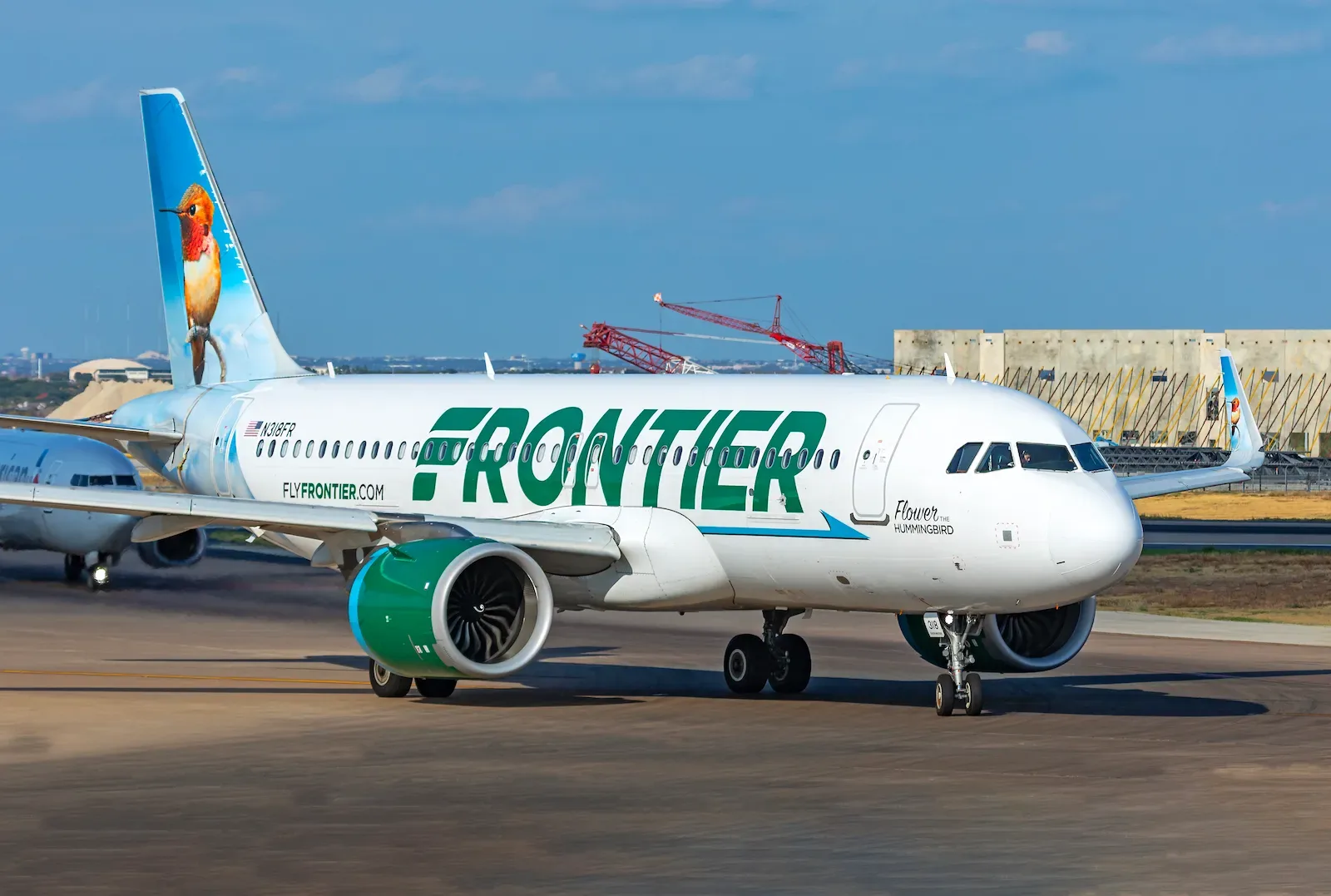
This Budget Airline Just Added Its First Flights to South America, From $99
Headlines are circulating about a budget airline's first nonstop flights to South America from $99, but the confirmed details are thin. Here's what to check before you book.
· 3 min read
Thailand Visa Rules Change for UK Travellers From 15 September
The UK Foreign Office has flagged incoming changes to Thailand's visa rules from 15 September, but the specifics are still thin on the ground.
· 2 min read