Bro Featured
When Will Sri Lanka's Free Visa Scheme Launch?
As of 30th March, 2026, Cabinet approval has been granted, but parliamentary approval is still pending.
By Nathan James
|(Updated 29 aprile 2026)· 7 min read
Sri Lanka's Free Visa Scheme: Cabinet Approves Draft Regulation, Parliamentary Vote Expected
In late July 2025, Sri Lanka's government announced plans to waive visa fees for citizens of 40 countries, expanding significantly from the smaller group that previously benefited from fee-free visas. The objective is straightforward: make travel to Sri Lanka more accessible and affordable, particularly for long-haul travellers, as the country pushes to rebuild momentum in its tourism sector.
The move is part of an ambitious target to attract 3 million international visitors in 2025 and generate approximately $5 billion in tourism revenue. Tourism remains one of Sri Lanka's most critical foreign exchange earners, and easing entry requirements is seen as one of the fastest ways to stimulate demand.
Latest Development: Cabinet Approves Draft Regulation (30th March, 2026)
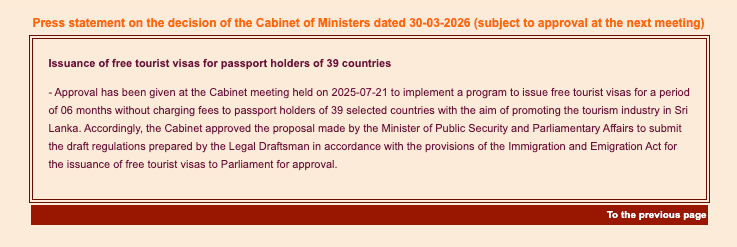
The process is moving forward, but it is not yet fully complete. According to the official statement on the decisions made by the Cabinet on March 30, 2026, the Sri Lankan government approved the proposal submitted by the Minister of Public Security and Parliamentary Affairs to present to Parliament the draft regulation governing the issuance of free tourist visas.
The text, prepared by the legal draftsman in accordance with the Immigration and Emigration Act, must now receive parliamentary approval. This marks a decisive procedural step, but not yet the formal entry into force of the scheme. As Sri Lanka's Minister of Foreign Affairs and Tourism, Vijitha Herath, had previously stated, the free visa program would be finalized and submitted to the Cabinet, with parliamentary approval targeted for April. The decision taken on March 30 confirms that this timeline is accelerating.
Which Countries Are Eligible?
At the press conference following the Cabinet meeting on March 30, government spokesperson Nalinda Jayatissa presented the list of countries expected to benefit from the measure. A list of 40 countries whose nationals are expected to become eligible for a free Electronic Travel Authorization (ETA) has been released, though some ambiguity remains around the exact scope.
Here are the 40 countries currently included:
Australia, Austria, Bahrain, Belarus, Belgium, Canada, China, Czech Republic, Denmark, Finland, France, Germany, India, Indonesia, Iran, Israel, Italy, Japan, Kazakhstan, Kuwait, Malaysia, Nepal, Netherlands, New Zealand, Norway, Oman, Pakistan, Poland, Qatar, Russia, Saudi Arabia, South Korea, Spain, Sweden, Switzerland, Thailand, Turkey, United Arab Emirates, United Kingdom, and United States.
Note: China, India, Indonesia, Japan, Malaysia, and Thailand already benefit from free ETA issuance under existing arrangements.
What Is the Difference Between a Visa Waiver and a Fee Waiver?
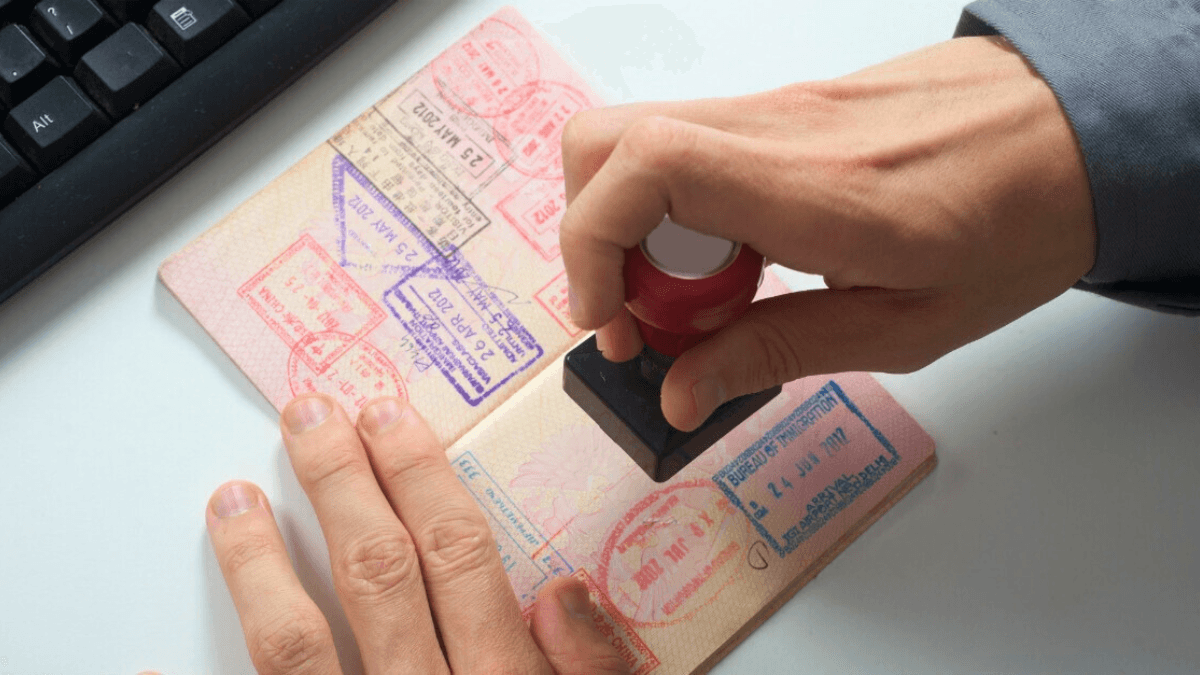
It's important to clarify an often-misunderstood detail: this is not a visa waiver. Travellers would still be required to apply for a tourist visa or ETA, but the visa fee itself would be removed. In practical terms, this reduces cost but does not eliminate paperwork or approval requirements. All standard eligibility criteria and security checks remain in place.
Why Is Sri Lanka Introducing a Free Visa Fee Waiver?
Sri Lanka's tourism recovery has been uneven following recent economic and political challenges. While arrivals have improved, officials believe visa costs remain a barrier, particularly for budget travellers, backpackers, and families comparing destinations across Southeast and South Asia.
For price-sensitive travellers, even a relatively small visa fee can influence destination choice, especially when neighbouring countries offer simpler or cheaper entry. By waiving visa fees, Sri Lanka hopes to reduce upfront costs, encourage longer stays, and ultimately signal that the country is 'open for tourism' again, especially following recent flooding.
According to Sri Lanka's Foreign Affairs and Tourism Minister, the Cabinet has already approved the proposal to eliminate visa fees for travellers from the expanded list of countries. If implemented, this would position Sri Lanka more competitively against regional rivals such as Thailand, Malaysia, and Indonesia, many of which already offer visa-free or low-cost entry options.
Key target markets include the United States, United Kingdom, Canada, Germany, Australia, as well as several Middle Eastern nations, all of which are viewed as high-value, long-stay, or repeat-visit markets.
When Will the Free Visa Scheme Come Into Effect?
The scheme was originally due to come into effect in January 2026. However, while Cabinet approval has been granted on March 30, 2026, and discussions are ongoing at ministerial level, Sri Lanka's government has not yet announced a specific start date for implementation.
According to several newsworthy sources, from March 2, 2026, significant delays to ETA approvals were reported, indicating technical issues that could be behind the delay. There have been no recent updates on either the Sri Lanka ETA or Department of Immigration and Emigration Sri Lanka websites.
Current Status: Parliamentary approval is now the next critical step. Once lawmakers approve the draft regulation, Sri Lanka will need to clarify the entry-into-force date and final implementation procedures. For travellers, caution is still advised—the scheme is not yet fully operational.
Frequently Asked Questions
When will the free visa scheme actually start?
The scheme was originally scheduled for January 2026 but has been delayed. Cabinet approval was granted on March 30, 2026, and parliamentary approval is expected in April 2026. Until both approvals are complete and the regulation is implemented, the scheme remains non-operational. Check the Department of Immigration and Emigration Sri Lanka website for updates on the implementation date.
Am I eligible for the free visa if I'm from one of the 40 countries?
If your country is on the approved list (Australia, Austria, Bahrain, Belarus, Belgium, Canada, China, Czech Republic, Denmark, Finland, France, Germany, India, Indonesia, Iran, Israel, Italy, Japan, Kazakhstan, Kuwait, Malaysia, Nepal, Netherlands, New Zealand, Norway, Oman, Pakistan, Poland, Qatar, Russia, Saudi Arabia, South Korea, Spain, Sweden, Switzerland, Thailand, Turkey, United Arab Emirates, United Kingdom, or United States), you should be eligible once the scheme is formally implemented. However, some countries (China, India, Indonesia, Japan, Malaysia, and Thailand) already have free ETA access.
Do I still need to apply for a visa if fees are waived?
Yes. The free visa scheme waives the fee for an ETA or tourist visa, but you still need to apply online and receive approval before travel. All security checks and eligibility requirements remain in place. The waiver only removes the cost, not the application process.
Why has the implementation been delayed?
According to reports from March 2, 2026, technical issues with ETA approvals have contributed to delays. Additionally, the draft regulation must pass parliamentary approval before the scheme can be formally implemented, which adds another procedural step beyond Cabinet approval.
What is the difference between a visa waiver and the Sri Lankan free visa scheme?
A visa waiver means citizens don't need to apply for a visa at all—they can enter visa-free. Sri Lanka's scheme is a fee waiver: citizens still must apply for and receive approval for a tourist ETA, but the processing fee is eliminated. The paperwork and approval process remain mandatory.
How long will the free visa scheme last?
The scheme is designed as a temporary six-month initiative to boost tourism during the recovery period. This duration has been used in past visa promotion schemes by Sri Lanka.
Which countries already have free ETA?
Six countries on the 40-country list already benefit from free ETA issuance: China, India, Indonesia, Japan, Malaysia, and Thailand. Citizens of these nations will not see a change once the scheme is implemented, as they already have free access.
Will the free visa scheme apply to all types of visits?
The scheme is specifically for tourist visas and ETAs. Business visas and other visa types are not expected to be included in the waiver.
How do I apply once the scheme is live?
Once implemented, you can apply through the Sri Lanka ETA online portal, or the Department of Immigration and Emigration website. The application process will remain the same; only the visa fee will be waived.
Has parliament approved the scheme yet?
As of March 30, 2026, Cabinet approval has been granted, but parliamentary approval is still pending. The government is targeting April 2026 for parliamentary approval. Until both Cabinet and Parliament have approved the regulation, the scheme cannot be formally implemented.
Want to come back to this?
#Sri Lanka#Visa#Tourism#South East Asia#Backpacking
Comments(1)
D
Dan7 Apr 2026
Just paid $100 for another month, this can't come soon enough!
BB
BudgetBroTeam
Damn! Fingers crossed for you it's soon :)