Bro's Blogs
Cambodia Khmer New Year 2026
If you've experienced Songkran in Thailand and expect the same thing here, you'll be surprised.
By Nathan James
|(Updated 29 aprile 2026)· 10 min read
What Is Khmer New Year? A Budget Traveller's Guide to Cambodia's Biggest Festival
Khmer New Year, known locally as Chaul Chnam Thmey (which translates to "entering the new year"), is Cambodia's most important festival. It runs for three days every April and marks the end of the harvest season and the start of a new cycle in the traditional Khmer calendar. 2026 is the Year of the Horse.
If you've experienced Songkran in Thailand and expect the same thing here, you'll be surprised. Khmer New Year shares the same ancient roots (both trace back to the Sanskrit word Sankranti, meaning the sun's transition into Aries) but the vibe is completely different. Where Songkran has evolved into the world's biggest water fight, Cambodia's version leans much more heavily into family, tradition, and Buddhist ritual. It's quieter, more personal, and in many ways more meaningful.
That doesn't mean it's boring. Pagodas fill up with offerings, traditional games take over temple courtyards, families who've spent months apart reunite, and entire cities change rhythm for three days. If you want to see Cambodia at its most authentic, this is the time.
I'm based in Cambodia and this is my favourite time of year here. The pace of everything shifts. Phnom Penh empties out as people head back to their home provinces, and the whole country slows down in a way that feels genuinely restorative.
For budget travellers, it's also incredibly affordable. Cambodia is already one of the cheapest countries in Southeast Asia, and Khmer New Year's best experiences (temple visits, traditional games, street food, community celebrations) cost nothing.
When Is Khmer New Year 2026?
Khmer New Year 2026 runs from Monday April 14 to Wednesday April 16. The dates shift slightly from year to year depending on astrological calculations tied to the solar calendar, but the festival always falls in mid-April.
Each of the three days has its own name and purpose:
Day 1: Maha Sangkran (April 14) marks the arrival of the new angel (Tevoda) who will watch over the world for the coming year. Families clean and decorate their homes, prepare offerings of fruit, candles, incense and flowers, and visit pagodas to offer food to monks and receive blessings.
Day 2: Veareak Vanabat (April 15) is the day of giving. The focus turns to charity, with families donating to those in need and visiting monasteries to honour ancestors. Children give gifts to parents and grandparents as a sign of respect. In the afternoon, people build sand stupas at temples and ask monks to bless the spirits of deceased relatives.
Day 3: Veareak Laeung Sak (April 16) is when the new year officially begins. The main ceremony, Pithi Srang Preah, involves bathing Buddha statues with perfumed water to wash away bad deeds and welcome good fortune. Children also wash their parents and grandparents with scented water, seeking forgiveness and blessings for the year ahead.
Where to Celebrate Khmer New Year?
Siem Reap
Siem Reap is the epicentre of Khmer New Year celebrations, largely thanks to the annual Angkor Sankranta event organised in front of Angkor Wat and along the river through town. Cultural performances, traditional games, parades, folk music, and huge crowds of Cambodians travelling from across the country make it the most energetic place to be.
Fair warning: if you normally visit Angkor Wat and enjoy having space to yourself, this is the opposite of that. The temple complex gets packed. But that's also kind of the point. Seeing Angkor filled with Cambodian families celebrating their own heritage rather than just tourists is something else entirely.
Siem Reap is already one of the cheapest cities in Southeast Asia. Hostels run from $5 to $10 a night, street food meals cost $1 to $3, and a tuk-tuk around town is a couple of dollars.
Phnom Penh
Here's the thing about Phnom Penh during Khmer New Year: it goes quiet. Most of the capital's population originally comes from other provinces, and when the festival hits, they head home. Streets that are normally gridlocked become almost empty. Many local restaurants and small shops close for the three days.
That said, Phnom Penh has its own celebrations centred around Wat Phnom, with cultural activities, ceremonies, and performances. Tourist-facing restaurants and hotels stay open. If you want a calm, almost surreal version of Phnom Penh where you can explore the city without the usual chaos, Khmer New Year is oddly one of the best times to be there.
Phnom Penh is slightly pricier than Siem Reap but still very affordable. Expect to spend $20 to $30 a day covering a dorm bed, three meals, local beers, and getting around by Grab. The US dollar is accepted everywhere, and you can get change in Cambodian riel and /or both.
Provincial Towns and Villages
For the most authentic experience, head to smaller towns. Battambang, Kampong Cham, and Takeo all hold local celebrations with traditional games, community gatherings, and pagoda ceremonies that feel completely untouched by tourism. If you have a local friend or are staying with a host family, being invited to join their New Year celebrations is one of the most genuine cultural experiences you can have in Southeast Asia.
Budget note: Provincial Cambodia is extraordinarily cheap. Guesthouses for $5 a night, full meals for under $2, and transport between towns by local bus or shared minivan for a few dollars.
What Happens During Khmer New Year?
The religious ceremonies are the core of the festival, but there's a lot more going on around them.
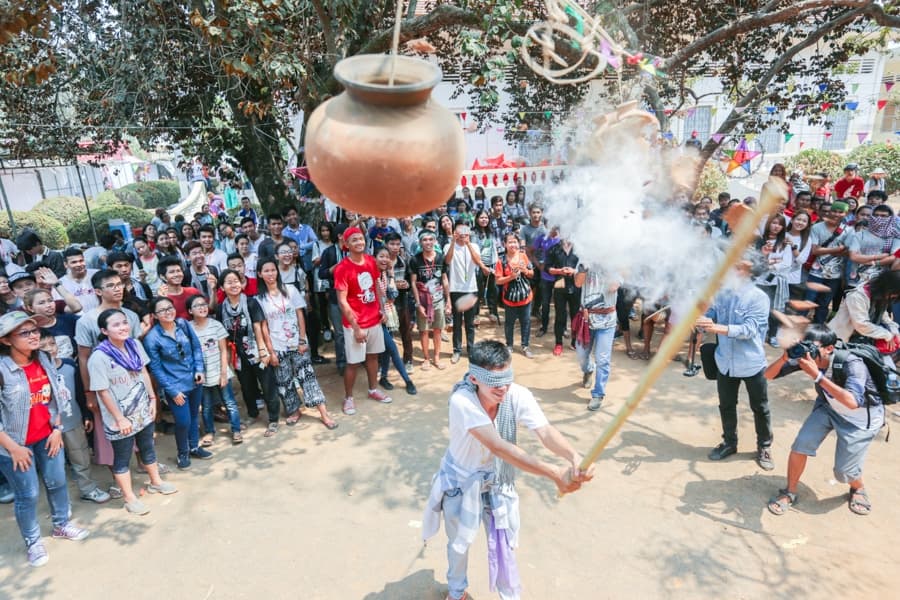
Traditional games take over temple courtyards and open spaces. Chol Chhoung involves two teams throwing a rolled-up cloth back and forth, with the losing side having to dance for the winners. Leak Kanseng works like a Khmer version of duck-duck-goose, where someone sneaks a scarf behind a player sitting in a circle. Bos Angkunh is a seed-tossing game played with hard nuts. These games bring together adults and kids, and tourists are usually welcome to join in.
Food is a huge part of the celebration. Look out for kralan (sticky rice mixed with beans, coconut milk and grated coconut, stuffed into bamboo and roasted over coals), num ansom chek (banana sticky rice cakes wrapped in banana leaves), and somlor machu kroeung (a sour soup with fish, lemongrass and tamarind that cuts through the April heat).
Music and dance appear at pagodas and community events. Apsara dance, which dates back to the Angkor era, is performed during larger celebrations. In rural areas, you'll hear classical Khmer music and see community dancing that goes on well into the evening.
Important for 2026: The Water Ban
If you're coming from Thailand's Songkran and expecting water fights, you need to know this: in 2026, the Cambodian government has banned water throwing, water guns, coloured water, and fireworks during Khmer New Year in Phnom Penh; and at least seven provinces including Siem Reap and Battambang.
This is a deliberate move to steer the festival back toward traditional Khmer culture rather than letting it become a copy of Thailand's water party. In previous years, younger Cambodians had started adopting the water-throwing trend, but the government has firmly pushed back.
Respect the rules. This isn't Songkran, and Cambodia takes its cultural identity seriously.
Frequently Asked Questions About Khmer New Year
Is Khmer New Year the same as Songkran?
Not exactly. They share the same ancient roots. Both trace back to the Sanskrit concept of Sankranti (the sun's passage into Aries) and both are celebrated in mid-April across several countries in the region, including Laos (Pi Mai) and Myanmar (Thingyan). But the festivals have evolved very differently. Thailand's Songkran is now famous worldwide as a massive water fight. Cambodia's Chaul Chnam Thmey is centred on Buddhist ritual, family reunions, charity, and traditional culture. Water pouring happens as part of religious ceremonies (bathing Buddha statues and elders), but the street water fights that define Songkran are not part of the Khmer tradition, and in 2026, water throwing has been officially banned in major Cambodian cities.
When is Khmer New Year 2026?
April 14 to 16, 2026. The dates shift slightly each year based on solar astrological calculations, but the festival always falls in mid-April. It's a national public holiday, so government offices, schools, and most businesses close for all three days.
How do you say Happy New Year in Khmer?
"Sousdey Chnam Thmey" (សួស្តីឆ្នាំថ្មី), pronounced roughly "soos-day ch-nam t-may." You might also hear "Rik Reay Chnam Thmey" which carries a similar meaning. Using either phrase with locals will always get a smile.
Are shops and restaurants open during Khmer New Year?
It depends on where you are. In Phnom Penh, many local restaurants and family-run shops close because their owners return to their home provinces. Hotel restaurants, tourist-oriented places, and international chains stay open. In Siem Reap, the tourist infrastructure keeps running, but smaller local businesses may close. In provincial towns, almost everything shuts down for the festival. Stock up on essentials before Day 1 if you're in a smaller town.
Can tourists participate in Khmer New Year?
Absolutely. Tourists are welcome at public celebrations, cultural events, and pagoda ceremonies. If you visit a temple, dress respectfully (cover shoulders and knees), remove your shoes before entering, and ask before photographing people or rituals. If locals invite you to join traditional games or share food, accept. Khmer hospitality during New Year is genuinely warm.
What is the zodiac animal for Khmer New Year 2026?
2026 is the Year of the Horse in the Khmer zodiac. The Khmer calendar follows a 12-year animal cycle similar to the Chinese zodiac but with some differences in naming and cultural significance.
How much does it cost to experience Khmer New Year on a budget?
Khmer New Year's best experiences are free: temple ceremonies, traditional games, cultural performances, and street food stalls. Cambodia as a whole is one of the cheapest countries in Southeast Asia. Budget travellers can comfortably get by on $20 to $30 a day covering accommodation, food, local transport, and drinks. Siem Reap and provincial towns are even cheaper. The main cost to watch is accommodation during the festival period, as domestic travel peaks and rooms in popular areas book out early.
Is it safe to travel during Khmer New Year?
Generally yes, but be aware of a few things. Road traffic increases significantly as millions of Cambodians travel between provinces, and road safety standards in Cambodia are lower than in neighbouring countries. If you're on a motorbike, be extra cautious. Medical infrastructure outside Phnom Penh and Siem Reap is limited. Also note that in 2026, the Thailand-Cambodia land border remains closed due to ongoing tensions. If you were planning to combine Songkran and Khmer New Year overland, that's not currently an option. Fly in directly instead.
What food should I try during Khmer New Year?
The festival has its own signature dishes. Kralan is the standout: sticky rice mixed with beans, coconut milk and grated coconut, packed into bamboo tubes and slow-roasted over charcoal. Num Ansom Chek is a sweet sticky rice and banana cake wrapped in banana leaves. For something savoury, somlor machu kroeung is a sour soup with fish, lemongrass, turmeric and tamarind that's perfect in the April heat. Street vendors sell all of these during the festival, usually for well under $1 each.
Experience Khmer New Year Your Way
Khmer New Year is one of those festivals that rewards you more the less you plan. Wander into a temple, accept the food someone offers you, sit down and watch a game of Chol Chhoung, and let the festival happen around you. It's not flashy. It's not Songkran. But it's deeply genuine, and that's what makes it worth experiencing.
If you've celebrated Khmer New Year before, I'd love to hear where and what it was like. And if you're in Cambodia right now for it, Sousdey Chnam Thmey from all of us at BudgetBro.
Drop your tips and experiences in the comments! Where are you spending it?
Want to come back to this?
Comments
No comments yet. Be the first to share your thoughts.